
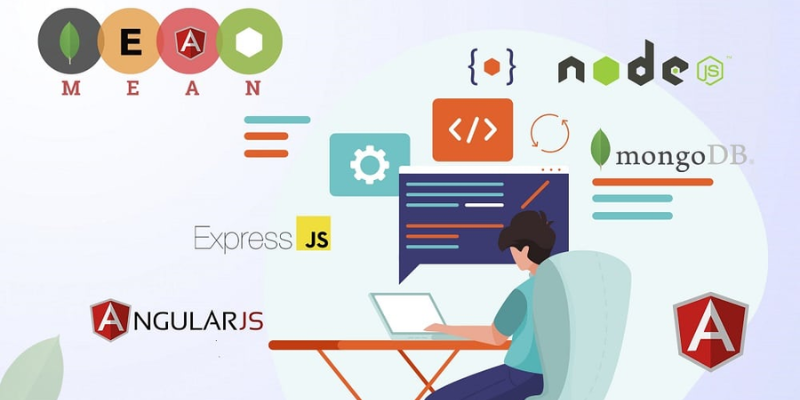
The MEAN stack is currently one of the most popular choices for full-stack web development. As JavaScript continues to dominate both frontend and backend development, developers are drawn more and more to a single-language solution. That streamlines the development process. Angular, Node.js, Express.js, and MongoDB make up the MEAN stack, which offers a complete framework for developing innovative, scalable web applications. Discover detailed MEAN stack concepts supported by practical examples and professional insights that boost your full-stack development capabilities. FITA Academy provides hands-on MEAN stack training that equips learners with essential skills in MongoDB, Express.js, Angular, and Node.js, enabling you to build scalable web applications and streamline development workflows with real-world project experience.
What the MEAN Stack Is
The abbreviation MEAN stands for MongoDB, Express.js, Angular, and Node.js, all of which are essential components of full-stack development. MongoDB is a NoSQL database that enables scalable and schema-less data management by storing data in adaptable documents that resemble JSON. Running on Node.js, Express.js is a lightweight backend framework that manages server-side functionality, middleware, and routing. Angular is a robust front-end framework that offers tools for creating dynamic single-page apps. JavaScript may run on the server side thanks to Node.js, which acts as the runtime environment.
Using the MEAN Stack
The MEAN stack has a number of strong benefits. First, it minimizes context switching and learning curves for developers by using a single language, JavaScript, for both the frontend and the backend. Second, it is very scalable: Node.js’s event-driven architecture and MongoDB’s adaptable schema make it perfect for applications that need to handle data in real time. Third, because the stack is open-source, developers have access to a sizable community as well as an abundance of tools, tutorials, and libraries.
Furthermore, Angular offers modular components and two-way data binding. Which expedites the creation of dynamic user interfaces. Developers gain from a streamlined workflow and uniform technology stack. While companies profit from quicker time-to-market and simpler maintenance. Boost your web development career with MEAN Stack Training in Chennai. Where you’ll master MongoDB, Express.js, Angular, and Node.js, learning to build scalable, full-stack applications and streamline development workflows with hands-on projects.
Setting Up the Development Environment
Setting up your MEAN stack environment correctly is essential before you start coding. Installing Node.js is the first step, as it comes with npm (Node Package Manager). Which is necessary for dependency management. Install MongoDB after that, making sure it runs locally, or establish a connection to a cloud instance such as MongoDB Atlas. To effectively create and manage Angular projects on the frontend, install the Angular CLI using npm.
Lastly, install the necessary Angular and JavaScript extensions and set up a coding editor such as Visual Studio coding. Make sure your project structure is correct by creating distinct directories for your frontend and backend once your environment is ready. Effective MEAN stack development is made possible by proper configuration, which also reduces errors and guarantees seamless component integration.
a Simple MEAN Application
There are a number of synchronized phases involved in creating your first MEAN stack application. Start by using the Angular CLI to create an Angular frontend and generate UI components. Create a Node.js server on the backend and use Express.js to define routes for API endpoints. Use Mongoose, a library that makes database interactions and schema development easier. To connect the backend to MongoDB. Put CRUD (Create, Read, Update, Delete) activities into practice so that your frontend can use the API to retrieve and modify data.
Use Postman to test endpoints to make sure the backend functions as it should. Lastly, send HTTP requests from Angular to your Express.js API to link the frontend and backend. This procedure illustrates a MEAN application’s entire lifecycle, from database to user interface. Learners who enroll in a Training Institute in Chennai for MEAN Stack Training develop strong full-stack development skills, gain expertise in MongoDB, Express.js, Angular, and Node.js, and improve their ability to design and build scalable, high-performance web applications.
Structuring MEAN Stack Projects
Scalability and maintainability depend on how well you organize your MEAN stack project. To adhere to the MVC (Model-View-Controller) structure on the backend, divide routes, controllers, and models into separate directories. Store utility functions, middleware, and configuration files in specific directories. Organize Angular modules and components logically on the front end, putting related features in one group.
To enable smooth transitions between development and production settings, use environment files for API URLs and credentials. Maintaining uniform file structures and naming conventions not only facilitates communication with other developers but also makes your project easier to traverse.
Debugging and Optimizing Performance
MEAN stack application optimization and debugging are continuous processes. To step through backend code, use tools like the VS Code debugger or Node Inspector. Angular offers comprehensive error messages and debugging tools for frontend problems. Reducing API calls, utilizing pagination for big datasets, and indexing MongoDB collections to speed up searches are all part of performance improvement. To find bottlenecks, use caching techniques and keep an eye on application logs. Additionally, use tools like PM2 for load balancing and Node.js process management.
You can guarantee quick response times, effective data handling, and an improved user experience by continually monitoring, profiling, and optimizing your application all of which are essential for contemporary online apps. We can also learn about the benefits of using the MEAN stack for development.
Integrating Additional Tools and Libraries
To improve functionality, a variety of tools and libraries can be added to the MEAN stack. For secure login systems, OAuth or JWT (JSON Web Tokens) can be used to add authentication. For real-time communication in chat or notification systems, use Socket.io. Angular libraries like NgRx offer state management for sophisticated apps for frontend improvements.
Robust and error-free code is ensured by testing frameworks like Mocha and Jasmine. Additionally, you can containerize your application to make it easy to deploy across various environments by integrating deployment tools like Docker. Developers can expand the MEAN stack’s capabilities and create complex, scalable apps by carefully adding new technologies.
Improving Workflow and Collaboration
For larger MEAN stack projects, effective workflow and teamwork are essential. For code management, use sites like GitHub or GitLab and version control systems like Git. To preserve code quality, use pre-commit hooks, formatting, and code linting. Effective task tracking, responsibility delegation, and sprint management are made possible by agile approaches and project management software like Trello or Jira.
To enhance knowledge exchange and uphold uniform coding standards, promote code reviews and pair programming. Teams can work together more easily, make fewer mistakes, and complete projects more quickly by using these techniques. Effective workflow practices guarantee the organization, maintainability, and scalability of MEAN stack projects of all sizes.
End Thoughts
A strong and adaptable option for full-stack JavaScript development is the MEAN stack. Developers can create cutting-edge, scalable online apps utilizing a single language throughout the full stack by comprehending MongoDB, Express.js, Angular, and Node.js. Efficient, maintainable, and high-performing applications are made possible by proper setup, project structure, performance optimization, and the incorporation of extra tools. Learning the MEAN stack gives you the ability to take on challenging online projects and maintain your competitiveness in the quickly changing IT sector, regardless of your level of expertise as a developer. You may develop dynamic, feature-rich apps that satisfy real-world needs with the help of the techniques described in this guide.
